
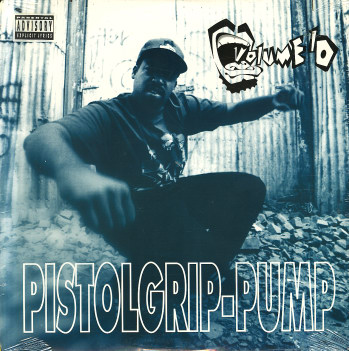
“Pistolgrip Pump” is one of my favorite L.A. hip-hop songs. Back in 2014, Eric Ducker wrote an incredibly thorough history of how the song came to be (and truly, the many ways in which it could have NOT come to be). Great music journalism at work but Eric wrote it for MySpace’s brief attempt to rebrand itself for content vs. “the social media platform that Facebook all but totally killed off.” Unsurprisingly, you can’t find it now but thanks to the WayBackMachine, you can find an archive of the original version here. And for the sake of anyone else looking, I’ve reposted the text of the story below.
(Also, “Pistolgrip Pump” is a sobering reminder of how the song ended up defining Volume 10’s style as something that was actually quite different from what it actually was. Listen to practically anything else on the album and his Good Life bonafides are instantly obvious).
How a Song No One Wanted to Make Became a West Coast Rap Classic
Volume 10 isn’t particularly hard to track down, but you get the feeling that these days he’s not really used to people looking for him. On a Wednesday afternoon earlier this year, he picks up the phone after a few rings, but before he’s ready for any questions, he has a few for me first. He asks what his rap name is (easy enough), then what song he’s known for (“Pistolgrip-Pump”). Then he tells me to say a few lines of “Pistolgrip-Pump.” If this is an attempt to check my rap bonafides, it’s lightweight stuff, but still, the whole deal has me a bit confused.
Then Volume 10 explains what’s up. It turns out that while we’re talking, he’s also hanging out with a woman he’s known for 10 years, but who didn’t know what he was doing back in 1994.
“I never told her who I was, and I decided to tell her,” he says. “The issue is that she didn’t believe me, brah. I showed her the [“Pistolgrip-Pump” video], and I’m like, ‘This dude don’t look like me?’ And she’s like, ‘He look like you, but you ain’t sing that song.'”
Apparently my responses have her convinced, so Volume 10 has her finish rolling a joint and he begins to talk…
This is the story of a rap obscurity. But looked at a different way, it’s the story of a hit that wasn’t even supposed to happen. To some it’s the story of a hit that should have been even bigger than it was. The complications of time, context and perspective have a way of tangling these things up. Now, 20 years since its release, Volume 10’s “Pistolgrip-Pump” has the rare distinction of being a song that both died a premature death and managed to achieve immortality.
The song itself starts with what sounds like “Atomic Dog” panting, courtesy of George Clinton, the patron saint of early 1990s Los Angeles hip-hop. Soon the beat overloads with insane elongated bass thumps, drum machine smacks, sanity-seekingguitar stabs, a sample of the King Ad-Rock’s voice sped up to the point of gibberish, what might be the anti-theft device on an alien warship and the mournful baying of another canine. What really sets “Pistolgrip-Pump” off though is the unhinged delivery of Volume 10, his bombastic voice dipping out and doubling up as he compensates for his paranoia with extra firepower.

“Pistolgrip-Pump” spent a little time in 1994 on Billboard‘s Hot R&B;/Hip-Hop Singles & Tracks and Hot Rap Singles charts, but didn’t really dent the playlist of Yo! MTV Raps or BET’s Rap City. And yet despite this seemingly ephemeral presence, it’s become a part of hip-hop’s DNA sequence, its mutated signature continually re-appearing over the past two decades.
The same year that “Pistolgrip-Pump” was released, New York City DJ and producer Ron G significantly modified its beat for the Uptown Mix of Miss Jones’ R&B; jam “Where I Wanna Be Boy.” Queen Latifah re-rapped its chorus in the lyrics to her 1996 song “Elements I’m Among” and a year later so did Louisiana’s Young Bleed on“How Ya Do Dat” from the soundtrack to Master P’s I’m Bout It.
Over the years, OutKast, E-40, WC, the Coup and Snoop Dogg have all sampled or referenced other Volume 10 lines from “Pistolgrip-Pump” in their songs. Psychopathic Rydas—a side project of Insane Clown Posse and other acts on their label Psychopath Records—took the beat wholesale for their track “Dumpin'” in 2000. That same year, Rage Against Machine released a Rick Rubin-produced version of “Pistolgrip-Pump” for their covers album Renegades alongside songs originally by Bob Dylan, Minor Threat, Afrika Bambaata and Bruce Springsteen.
Today, “Pistolgrip-Pump” gets played several times a week on KDAY, L.A.’s hip-hop oldies station, maybe not as frequently as “Nuthin’ But a G Thang” or “Dear Mama,” but it doesn’t sound out of place when played alongside them.
But hold on a minute…who the fuck is Volume 10 anyway?
Volume 10 was born Dino Hawkins in Inglewood. After spending some years living in Oakland as a kid, he returned to L.A. in the mid-1980s and attended the arts magnet middle school Hubert Howe alongside future L.A. rap luminaries Charli 2na of Jurassic 5, Son Doobie of Funkdoobiest and DJ Lethal of House of Pain. The first time Hawkins performed a rap he wrote was at the school’s talent show. “The whole house fell in love with hip-hop that day,” he says. “We caught the bug.”
A few years later, Charli 2na introduced Hawkins, who a was going by Double D at the time, to DJ and producer Cut Chemist. The two of them recorded 10 or so songs together at Chemist’s house. 2na told Volume 10 about The Good Life Cafe, a health food store in South Central that hosted a weekly event where for two hours every Thursday night, rappers could sign up to perform original songs or freestyle.
2na hadn’t even gone to The Good Life yet, but Volume 10 soon checked it out. He quickly became a regular and made an impression on Freestyle Fellowship, a group of lyrically dexterous and dictionary chopping MCs who were the champions of the scene.
“It wasn’t long before they put him down with the Heavyweights,” says Cut Chemist, referring to the group’s larger crew. “And it was tough to get respect from those guys.'”
While still in his late teens, Volume 10 was featured on “Heavyweights,” the posse cut from Freestyle Fellowship’s major label debut Innercity Griots. He also had an EP called Crazy As I Wanna Be that he was selling for $10 out of his pocket. “I was hot, but I didn’t have a deal,” he says.

Like many behind-the-scenes rap folks in the early ’90s, Adrian Miller simultaneously worked in multiple parts of the industry. He had helped engineer Freestyle Fellowship’s signing to Island Records, making them the first Good Life act to join a major. That experience eventually led to Miller working as an A&R; at Immortal Records, the label of Buzztone Management, the company that represented Cypress Hill and House of Pain, among others (The relationship between Immortal and Buzztone was similar to that of Def Jam and Rush Artist Management; there was staff crossover, but just because an act was on one, didn’t mean they were part of the other). Miller also wrote for Rap Pages magazine and helped on “Friday Night Flavas,” the Power 106 radio show of the Baka Boyz, who he was managing at the time.
Immortal Records had a deal with RCA, but when the artist they had lined up to deliver an album got committed to a mental hospital, the slot opened up. Miller suggested Ras Kass, who he was close with, as a possible alternative, but then Ras Kass got in a car accident that led to a jail stint, sidelining his career for a few years.

Adrian Miller and James Andrews (marketing director of Immortal Records at the time, currently of Social People) on the Baka Boyz’s “Friday Nite Flavas” show. Photo courtesy of Adrian Miller
With the spot available again, Miller proposed Volume 10. Miller didn’t know that at the time, Volume 10 had teamed with Ganja K, another Good Life MC, to form a group in order to get label attention. Immortal Records was open to signing the new duo, but when there were issues with Ganja K’s manager, the deal went to Volume 10 as a solo act.
But problems started almost as soon as work began on the album that would become Hip-Hopera. “From day number one, Volume 10 was a self-mission,” says Miller. “He wasn’t interested in being a player on the team.”
“I was a hard person to deal with,” Volume 10 admits.
Many of the rappers from The Good Life saw themselves in the tradition of jazz artists as they stretched the possibilities of lyrical delivery and content. Though Volume 10 might have been on the forefront on the artistic and technical aspects of MCing, the songs he was interested in making weren’t likely to sell many records and as recording began wrapping up on the album, it became clear to Miller that the project desperately needed something that might actually get played on the radio. Volume 10 wasn’t into it.
“He fought me tooth and nail,” says Miller. “I was like, Bro, I gave you a record deal. If you don’t have a hit single, you ain’t never going to see the light of day. Come with something.”
Miller also admits that as a young and ambitious A&R;, of course it was in his interest for the album to be a success. Immortal Records/Buzztone was already responsible for monster party hits like House of Pain’s “Jump Around” and Funkdoobiest’s “Bow Wow Wow,” and his project couldn’t be a dud. “I wasn’t going to come with the first record that I’m executive producing and it’s a wack record with no single,” says Miller.
Volume 10 had been working with producers like Fat Jack and Bosco Kante. Miller set him up with the Baka Boyz, the brother duo of Nick and Eric Vidal,who weren’t associated with The Good Life or the music performed there, but did have the biggest and most important hip-hop show on commercial radio in Los Angeles. The pair had been producing for acts including Yo-Yo and Kid Frost. Miller told them to make Volume 10 a beat in the style of two recent L.A. trunk thumpers, Low Profile’s “Pay Your Dues” and Kam’s “Peace Treaty.”

This approach wasn’t the usual territory of the Baka Boyz either and wasn’t somewhere they were interested in going.
“Let me be clear about actually making ‘Pistolgrip-Pump,’ it was a record that we did not want to make,” says Nick Vidal. “At that point in time, that was not our sound. That West Coast sound, it was Zapp & Roger, it was regurgitated. We were chasing [DJ] Muggs—the screeching, the backwards samples, that whole Cypress Hill sound. That was what we were inspired by.”
Recorded in the production studio of Power 106, these sessions where neither the MC nor the producers were excited about what they were making were contentious. “Volume 10 was extremely difficult to work with,” says Nick. “He was very confrontational, and I’m a confrontational individual as well. I wouldn’t back down to him, so we would have it out.”
Miller had just been to Houston for Rap Sheet, where he was working on a story about Texas hip-hop. While there he interviewed Bun B of the Port Arthur duo UGK. Miller was heavily into their song “Pocket Full of Stones,” which was featured on the Menace II Society soundtrack. Instead of telling Volume 10 to rap his version of “Pocket Full of Stones” over the beat, Miller said he should use Bun’s line “Pistolgrip-pump on my lap at all times, niggas fuck with other niggas’ shit, but they don’t fuck with mine” as a starting off point.

As to whether rappers who have subsequently used “pistolgrip-pump on my lamp at all times” are quoting Volume 10 or Bun B, I’d say it’s the former because of the way they pronounce the word “pump.” And as to how the original line came to be, Bun B says, “That was just the kind of gun I had at the time that I was riding around with.”
To illustrate the two main worlds of Los Angeles hip-hop of that era, some will point out that Dr. Dre’s The Chronic and The Pharcyde’s Bizarre Ride II the Pharcyde were released within weeks of each other in 1992. While there are plenty of stylistic arguments about why it’s ridiculous to believe that one exemplifies L.A. gangsta rap and the other represents the city’s underground scene, it also diminishes that most of the people from these two camps came from the same neighborhoods and went through the same things.
While Volume 10 may not really have been that interested in rapping about gangster shit, he was one of the more gangsterish MCs at The Good Life and could rap about that world honestly. Even with his record deal he says he was still living in a Harlem Crip neighborhood on 39th and Western, where guys were making vaguely threatening comments to him about how he was probably keeping his album advance money in the rafters.
“The concept [of “Pistolgrip-Pump”] was simple. The thought of carrying around your gun is not something as a Good Lifer I was really writing about,” says Volume 10. “We were thinking deeper than that.”
Even the first line of “Pistolgrip-Pump” can be interpreted as Volume 10 being bored by the subject he’s about to go off on: “I was raised in the hood called… What’s the diff?” While many rappers proudly and continuously boast about what notorious place they came out of, to Volume 10 it didn’t matter, they were all bad.
Maybe more frustrating to Volume 10 than the song’s content was the changes he had to apply to his unpredictable flow. The song lacks, or at least dampens, the volatility he was known for.
“It was about as watered down as I was willing go,” says Volume 10. “It was bubblegum to me. It was a simple rap for me. I was on the edge of insanity with my raps. I didn’t have a pattern. In that song I put myself in constraints. I said, Listen, you’re going to stay on this beat and you’re going to ride this beat all the way through.”
Volume 10 and the Baka Boyz ended up doing several songs that made it to Hip-Hopera, with “Pistolgrip-Pump” as the obvious standout. Neither faction was particularly enthralled about the results. Nevertheless, Miller knew he had gotten what he wanted and how important the song would be in the neighborhoods around the country that he had been visiting for Rap Pages. “I had a baby,” he says. “They were like, ‘We should have aborted a long time ago.’ And I’m like, ‘Not after this labor, clowns. Watch what happens.'”
“Pistolgrip-Pump” was released as the first single from Hip-Hopera. It quickly found a following in Los Angeles in the streets and on some of the city’s college and independent radio stations. It was a strange era in the city. The Crips and Bloods had reached a ceasefire two years earlier and the homicide rate had been dropping, but after years of violence and death, people were still on edge, and often for good reason. “That was a Southern California state of mind,” says Adrian Scott, the current program director of KDAY, of the song’s message. “That’s how Los Angelinos felt at the time.”
Self Jupiter of Freestyle Fellowship was incarcerated when “Pistolgrip-Pump” was released, but even inside, people were on it. “All the inmates were going crazy for it,” he says. “The prisoners in California’s Department of Corrections was like, ‘Yeah, this motherfucker is moving.'”
As Miller predicted, the song started to find an audience outside of Los Angeles. Not only was it able to transcend regions, but by incorporating an element of Southern hip-hop, it was an early moment that helped legitimize the then-stepchild sound. “Him using that line acknowledged that we were making an impact on people in the industry,” says Bun B. “Him being way out in the West Coast was even more surprising.”

Baka Boyz in Adrian Miller’s office at Bein’ Lil Kids/Buzztone Management when he managed them.
In the early ’90s, being called a sellout was still a concern for rappers. It didn’t just happen if you made an obvious pop song or a pop-friendly career move, artists could get stuck with that tag for any stylistic switch up that seemed like it was done to attract a bigger audience. Regardless of the message and sound of “Pistolgrip-Pump,” Volume 10’s core continued to support him. In the documentary How the West Was Won, which covers the scene at The Good Life, there’s old video footage of him performing “Pistolgrip-Pump” at the store. When the beat is cut off in the middle of the second verse after he breaks the night’s strict no cursing policy, the crowd hollers out the rest of the lyrics for him.
“Dino sounds good watered down,” says Cut Chemist. “It wasn’t like it was wack, it just wasn’t as crazy as were used to him being. It’s not surprising it was his most enduring song, because it was just real clean, lean and mean”
At first the Baka Boyz didn’t even play “Pistolgrip-Pump” on “Friday Night Flavas.” “We wanted the record to stand on its own and we weren’t terribly excited about producing it,” says Nick. “We didn’t know how big it was going to be eventually.”
It took the hectoring of Miller, plus the label’s promotions team bringing it to the attention of Power 106’s program director that the Baka Boyz were behind it, before they started spinning it. And even then, because of the station’s recent decision to crack down on lyrics that advocated violence, they had to use an edit that changed the chorus’ lyrics to “Pump pump pump on my lap at all times.”
This is the point when this story has its inevitable downturn, though it happened much earlier than anyone really expected. Just as “Pistolgrip-Pump” started to really grow locally and nationally, Volume 10 gave up. He decided to stop promoting his music and didn’t want to tour any more. After that, his career as a rapper effectively ended for nearly two decades.
“Everybody wants to know what happened,” says Volume 10. “I got sick, they wouldn’t buy me insurance. As a 19-year-old who didn’t have any money—because of course I had blown through the advance they gave me by then—I was in between checks as I was on tour. The money they were giving was per diem money, you know, $25 a day or some shit. I’m like, ‘You’re crazy, you’re not going to give me insurance? You’ve got 25 people working for you.’ That’s what happened to my deal, dog.”
Now known as someone who was difficult to deal with, Volume 10 says he was blackballed from the industry and couldn’t get on another label. “I said, Fuck it, I’m tired of smashing my head against the wall trying to get work. So I stopped,” he says. “As an uneducated person, someone who spent all this educational years chasing music, I had nothing, bro.”
After that, things continued to get worse. He couldn’t, or wouldn’t, get a job outside of the music world. “It’s hard to be a telemarketer after you’re a rap star. People don’t allow you to do that, bro,” he says. “They’re like, ‘What the hell are you doing here? You’re Volume 10, go be a rapper.’ And it’s like, ‘Do you even know what you’re talking about? Leave me alone and let me be regular.'”
He never felt like he could be regular and his psychological outlook worsened. “I stayed in the house and made the woman and my children miserable,” he says. “I spiraled into depression and the depression put me into what I call the Lost Years. About 20 years went by without me really doing anything.”
Looking back at the situation now, Miller is sure to mention Volume 10’s talent and that now the two of them are on decent terms, but he still seems frustrated with the rapper’s decision two decades ago. He notes that it’s not the industry standard to give artists health insurance and that they’re supposed to do that with their advance money, if they want to. “How do you quit on your own hit record?” he says. “What type of mentality is that? He was his own worst enemy.”
Even if Volume 10 had continued working “Pistolgrip-Pump,” it’s unclear how big a success he could it have been. Hip-Hopera is a challenging and often cynical record with nothing else really like “Pistolgrip-Pump” on it. When asked about a hypothetical future where Volume 10 had kept going and whether he really could have built a career off of what he put out, Miller says, “What did The Pharcyde have after ‘Passin’ Me By’? What did Souls of Mischief have after ”93 ‘Til Infinity’? What did Ahmad have after ‘Back in the Day’? They all had these one-hit wonder vibes, and they all stayed moving, circulating. Even groups without hit records were touring, making bread.”
The rap lore goes that Ice Cube was in the audience at The Good Life before “Pistolgrip-Pump” was released and that it was after seeing Volume 10 perform that Cube switched up his style for his appearances on Da Lench Mob’s Guerillas in tha Mist album from 1992. Previously Ice Cube was steady in his flow, whether delivering lyrical fury or laidback storytelling, but here he pushed up his vocal modulations and went off-kilter. This perceived rip-off is why Volume 10 disses him with the “Pistolgrip-Pump” line, “I hang with my dogs, man, fuck a gorilla.” He also might be going after him in Hip-Hopera‘s opener “A’Capella/Stylesondeck.”
Miller sees this story as emblematic of why things didn’t work out for Volume 10, a man who held to his opinions so strongly that sometimes they seemed like acts of self-sabotage. Some consider rapper Mack 10’s debut single, “Foe Life,” which was produced by and features Ice Cube, to be a fairly obvious stylistic gank of “Pistolgrip-Pump,” and a not particularly subtle way of Cube flexing his power. Miller believes that had Volume 10 been more accommodating and less defiant towards Ice Cube, he could have been given the opportunities that the star eventually gave Mack 10.
Volume 10 recently began rapping again. It’s only been within the past year that he’s gotten active on social media and set up a SoundCloud page. He needed even more time to get his chops back. “It took three years of practicing and writing songs and free shows and starting past over. Dog, I was starting negative,” he says.
He’s now performing around Los Angeles. He played St. Fatty’s Day in Anaheim with Funkdoobiest and opened for Rakim at a club on Universal CityWalk. He says he has an album called Brain Damage, but he won’t put it out until he finds a label that can prove it has the promotional dollars to support it.
In the intervening decades since its release, people kept playing “Pistolgrip-Pump,” probably even more than they did when it first came out. It was licensed in ’90s movies like Set if Off and Things to Do in Denver When You’re Dead. Miller started getting paid for publishing on the song in 2004 and has actively and effectively tried to get artists to sample it. Both Volume 10 and the Baka Boyz say they like the song now.
“It puts a smile on my face when I hear it,” says Miller, “and I hear it a lot.”
Last year Los Angeles rapper Problem released his single “Like Whaaat,” which twists the “pistolgrip-pump on my lap at all times” line in the first verse. Problem was about eight years old when “Pistolgrip-Pump” was released, but he remembers his mom playing it and people going crazy to it at parties as he grew up. But tributes aren’t always straightforward in hip-hop and Problem’s use of the line is a part of him flipping the start of Young Bleed’s verse from “How Ya Do Dat,” which had it’s own flip of Volume 10’s line, which of course was a flip of Bun B’s line. “You never let the good die,” says Problem. “You show your appreciation for what was.”

On “What’s Up To…,” the last song from Hip Hopera, in the midst of a list of shoutouts, Volume 10 tosses off the line, “Don’t nobody last long in the tapedeck.” He’s right of course, but “Pistolgrip-Pump” has found its way into the rotation for longer than many that came before it or followed it. “I never think anything will have that kind of longevity,” says Cut Chemist, “but it certainly did.”
Photos courtesy of Adrian Miller

chatter